Tags
Six axes, none of them the category axis. Categories say what area an entry serves; these say what it works on, how it works, what can go wrong with it, and who it is for.
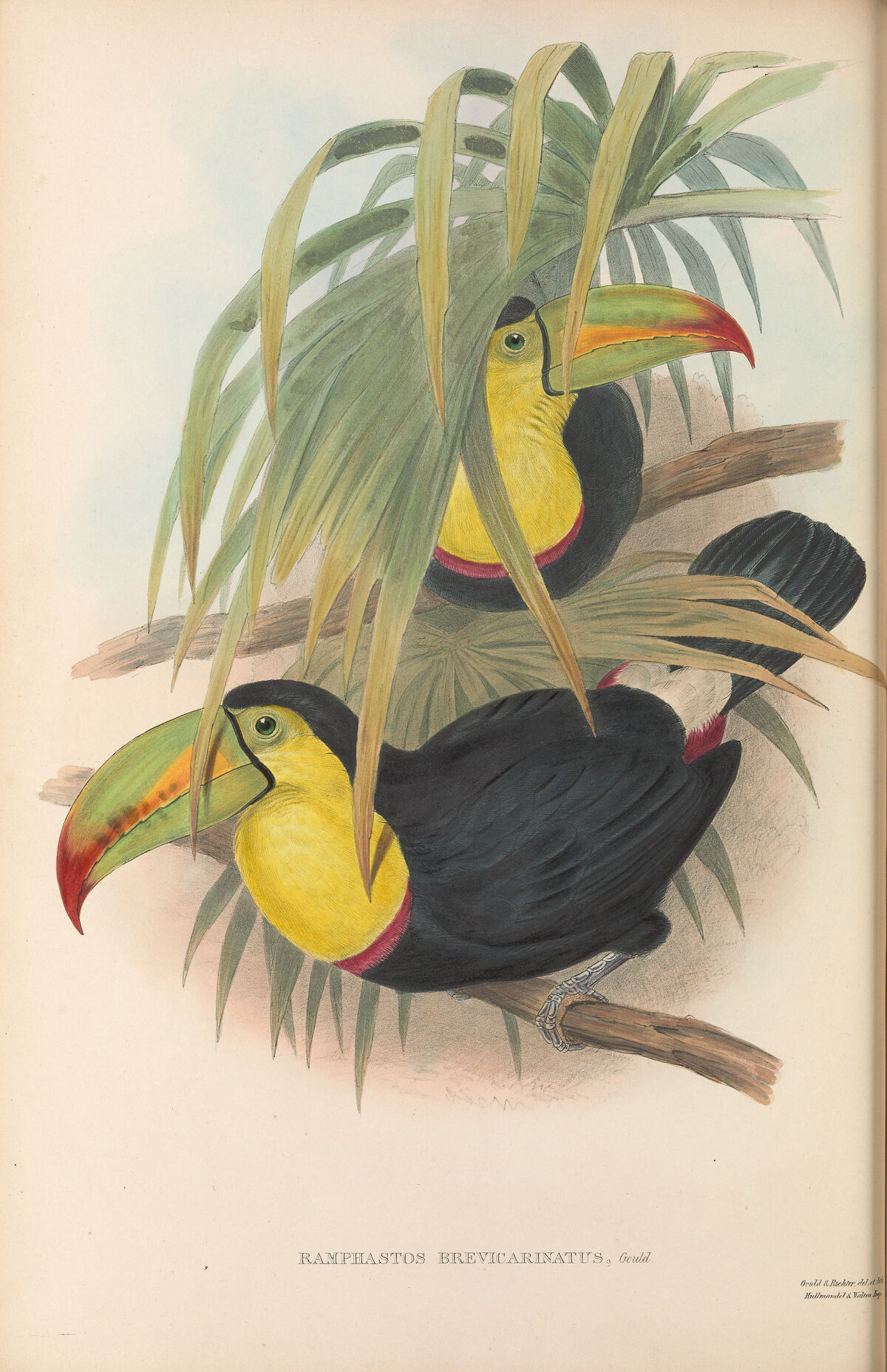
Ramphastos brevicarinatus, Gould., Short-billed Toucan [Pl. 3], John Gould and Henry Constantine Richter, del. et lith.; printed by Hullmandel & Walton, 1852. Biodiversity Heritage Library, scanned by Smithsonian Libraries. Public domain. Credits
29 tags across 6 axes · 0 of 29 in use · 0 of 91 entries tagged
Every tag is reserved
The vocabulary is registered; none of it is in use. Each tag has a permanent address so it can be linked and cited now, and each will carry entries once the vocabulary goes into use. A tag turns active only when it can truthfully assert membership — the build fails if an active tag has no members, or a reserved one has any.
The axes are also served as JSON at /api/tags.json, with the
emptiness stated field by field.
Artifact — what an entry works on
The material an entry reads or writes. Factual, and orthogonal to the category axis — one entry may work on two materials at once.
- Literature corpus 0 of 91 Entries that read a body of published work as their input — a search result set, a reading list, a field of papers. The corpus is what gets processed; whatever is written comes after. artifact:literature-corpus
- Manuscript 0 of 91 The material is a draft paper: its argument, its structure, its prose. A manuscript is a single document under active revision rather than a published record. artifact:manuscript
- Bibliography 0 of 91 Reference lists and citation records are the material — matching, deduplicating, resolving, or formatting the apparatus that connects a claim to its source. artifact:bibliography
- Tabular dataset 0 of 91 Entries that read or write structured rows and columns: survey responses, panel data, extracted variables. Excludes free text that merely happens to sit in a spreadsheet. artifact:tabular-dataset
- Interview transcript 0 of 91 Qualitative material captured as speech — interviews, focus groups, field recordings — where the unit of analysis is an utterance rather than a row. artifact:interview-transcript
- Analysis code 0 of 91 Entries that read or write the scripts that produce a result: cleaning, estimation, plotting. The code is the artifact under inspection, not the tool doing the inspecting. artifact:analysis-code
- Course material 0 of 91 Teaching documents are the material — syllabi, assignments, reading lists, rubrics. Naming this artifact implies no pedagogical capability. artifact:course-material
- Reviewer report 0 of 91 Entries that read or write referee reports and editorial correspondence, including the response letters that answer them. artifact:reviewer-report
Method — how an entry works
The machinery an entry uses to do its job. Factual: it says how, and never how well.
- Structured search 0 of 91 Queries run against a defined source with recorded parameters, so the same search can be run again and compared. Coverage is bounded and the bound is declared. method:structured-search
- Field extraction 0 of 91 Named fields are pulled out of unstructured or semi-structured material into a schema, leaving a trace from every extracted value back to where it came from. method:field-extraction
- Cross-reference check 0 of 91 The entry compares a claim against the source attached to it and reports agreement, disagreement, or an inability to check. A resolution failure is itself a result. method:cross-reference-check
- Schema validation 0 of 91 Material is tested against a declared shape, and a violation fails loudly instead of being coerced into the shape and passed on quietly. method:schema-validation
- Comparison and diff 0 of 91 The entry puts two versions of the same object side by side and reports what changed, including changes that are easy to miss by reading. method:comparison-diff
- Coding scheme 0 of 91 A defined qualitative coding frame is applied to material, recording which code was applied to which passage and preserving disagreement rather than resolving it silently. method:coding-scheme
- Drafting with citation 0 of 91 The entry writes prose in which every substantive claim carries a source that resolves. Drafting without that constraint is a different method and does not belong here. method:drafting-with-citation
Risk — what can go wrong
The failure mode to watch for when running an entry. An editorial axis, and the one we consider most load-bearing — none of it is in use yet, so no entry on this site has been inspected for risk.
- Fabricated citation 0 of 91 A source can be named that does not exist, or a real source attached to a claim it does not make. The check is resolution: every reference must resolve to a retrievable record. risk:fabricated-citation
- Silent omission 0 of 91 Material can be dropped without a word — a truncated result set, a skipped record, a filtered case — leaving output that looks complete and is not. risk:silent-omission
- Claim overreach 0 of 91 The entry can state a conclusion stronger than its evidence supports, most often by dropping the qualifier that made the original claim defensible. risk:claim-overreach
- Stale source 0 of 91 Material that has since been retracted, superseded, corrected or moved can be presented as current, because recency was never checked. risk:stale-source
- Irreproducible run 0 of 91 The entry can produce a result that a second run does not reproduce, because a parameter, a seed, a source version, or an ordering was never recorded. risk:irreproducible-run
- Confidential material 0 of 91 Point one of these at material under a confidentiality agreement, a licence restriction or an ethics protocol, and the output can leak it. Consent and confidentiality travel with the material. risk:confidential-material
- License terms 0 of 91 The entry can reproduce or redistribute material whose licence does not permit it, including scraped text and figures whose rights sit with a publisher. risk:license-terms
Audience — who it is for
Who an entry is aimed at. Editorial, and deliberately coarse — an entry may carry several.
- Doctoral researcher 0 of 91 The reader with more time than budget, running the project largely alone; the working steps have to stay visible. audience:doctoral-researcher
- Principal investigator 0 of 91 For someone responsible for work they did not personally execute, who needs to see what was checked and what was not before signing their name to it. audience:principal-investigator
- Research engineer 0 of 91 The reader who treats an entry as software: inputs, failure modes, determinism — and holds it to a tool's standard of behavior. audience:research-engineer
- Instructor 0 of 91 Written for preparing or running teaching, where the output will be read by students and must be defensible in front of a room. audience:instructor
- Research librarian 0 of 91 Aimed at someone whose expertise is in sources, retrieval and provenance, and who will judge an entry on whether its coverage claims are honest. audience:research-librarian
Curated — the curators’ own marks
Hand-maintained editorial assertions by the curators. There is deliberately no sync script for any tag in this namespace.
- Reference entry 0 of 91 The curators point at this one when explaining what the review standard asks for: it is the clearest worked example they have. curated:reference-kit
- Teaching example 0 of 91 Used by the curators when teaching, because its failure mode is easy to demonstrate and easy for a student to reason about. curated:teaching-example
Batch — publication cohorts
Publication cohorts — the freshness axis. Batch ids follow batch:yyyy-w##.
This axis is registered and has no tags yet. The first is minted when an entry first carries one.
The axes that are not tags
Two axes are stored fields on the record rather than tags, because each entry has exactly one value for them. They are linked here for one-stop discovery.
- Category — the area an entry serves, with its denominated counts.
- Status — live, archived, unavailable. An archived repository is still upstream; an unavailable one returned 404 when we retrieved, and its entry stays on the map with that date. See the standard.